

Guest article by Rayleen Hargreaves – Product Owner, Reconcilor | Vela Industries Group
The Cost of Being “Close Enough”
In mining, reconciliation rarely fails loudly. It doesn’t collapse or trigger alarms, and it doesn’t stop production. Instead, it quietly settles into a familiar and widely accepted phrase:
“It’s close enough.”
That phrase feels practical, sensible even. But “close enough” is not a neutral position. It is a financial decision, whether anyone intended it to be or not.
Tolerances are not harmless
Most sites operate with accepted reconciliation tolerances: a few percent on tonnes, a few grams on grade, or a small metal balance gap that is considered “within expectations”. Individually, these variances appear immaterial. Over time, they become normalised.
The problem starts when tolerances shift from being alerts to becoming targets. Once that happens, small variances stop being investigated. When investigation stops, value leakage does not need to be large. It just needs to be consistent.
Consistency, after all, is exactly what reconciliation is meant to detect.
“Within tolerance” is still a loss
A reconciliation that reports 97–98% agreement can feel reassuring. On paper, it looks controlled.
But reconciliation is not about comfort. It is about understanding.
That missing 2–3% may not be random. It may not average out. It may be pointing to a repeatable issue in mining, material handling, blending, or processing that is quietly being accepted because it sits inside a predefined band.
If it happens every month, it isn’t noise.
It is a signal that has been normalised.
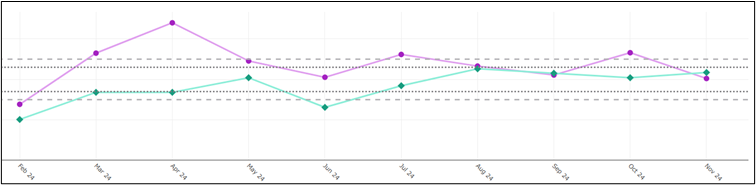
FIG 1: All results shown are within tolerance. The behaviour over time is not stable.
The compounding effect no one sees
The real cost of being “close enough” is rarely visible in a single reporting period. It emerges through accumulation.
Small, accepted variances begin to influence decisions well beyond reconciliation. Over time, they can distort model calibration, bias recovery assumptions, undermine forecast confidence, and mask systematic losses in stockpiles or plant circuits. None of these effects are dramatic on their own, but together they quietly erode value.
This is how sites lose metal without ever feeling like they have lost control.
When tolerance replaces curiosity
There is a subtle behavioural shift that occurs when tolerance bands dominate reconciliation discussions.
The question moves from “Why did this happen?” to “Is it inside the band?”
Once that shift occurs, reconciliation becomes a compliance exercise rather than a learning tool. Teams stop challenging whether tolerances are still appropriate, stop testing whether assumptions still hold, and stop tightening the system that produced the variance in the first place.
At that point, tolerance is no longer managing uncertainty. It is protecting it.
Tight systems reduce tolerance, not the other way around
High-performing sites do not begin with narrow tolerances. They earn them.
As data quality improves, material tracking becomes clearer, and interfaces between mining, stockpiles, and processing are better defined, tolerance bands naturally shrink. Not because someone mandates it, but because the system can support it.
When visibility improves, “close enough” becomes harder to justify.
The better question
Instead of asking whether a reconciliation result is within tolerance, a more useful question is:
“If this happens again next month, would we be comfortable?”
If the honest answer is no, then the issue is not the tolerance itself.
It is the quiet cost of accepting “close enough” for too long.
If you would like to contact the blog author, Rayleen Hargreaves – she’s always happy to discuss practical applications and answer any questions you may have.
📧 Contact: Rayleen.Hargreaves@dataminesoftware.com
🔗 www.dataminesoftware.com
If you would like to strengthen reconciliation capability within your team, we offer a practical 1-day Mastering Mine Reconciliation: Getting From Estimated to Actual training course. You can find the details here: https://snowdenoptiro.com/events/mastering-mine-reconciliation/, or contact us at training@snowdenoptiro.com for more information.
Snowden Optiro is a resources consulting and advisory group that provides independent advice, consulting and training to mining and exploration companies, their advisors and investors.
We help mine developers to advance their projects, mining companies to improve their operations and their professionals, and investors to de-risk their investments by the provision of quality advice, training and software in the field of Mineral Resources and Mineral/Ore Reserves.